Bulbasaur · Base Set, what to know.
About the Bulbasaur card
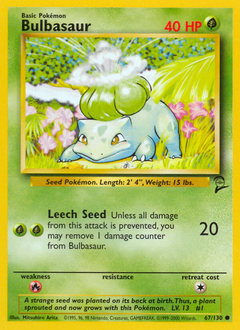
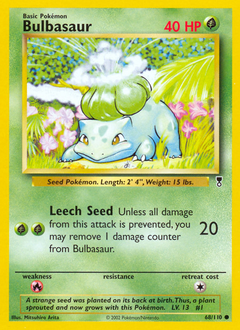
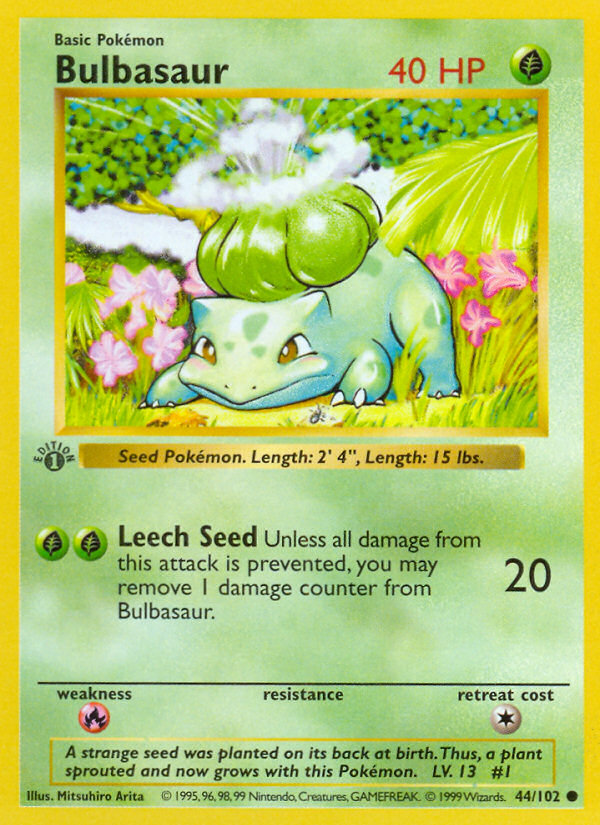
Bulbasaur is card 44 of 102 in Base Set, released in January 1999, a Common. It is a Basic Grass-type with 40 HP.
As a Basic Pokémon, Bulbasaur needs no prior evolution to put into play, which made it a practical card in the era's decks.
Illustrated by Mitsuhiro Arita. Arita painted the Base Set Charizard and much of the early holo run, and his work has a painterly weight that set the visual tone of the Wizards era.
The Pokédex entry printed on Bulbasaur reads: "A strange seed was planted on its back at birth. Thus, a plant sprouted and now grows with this Pokémon."
About Bulbasaur in the Pokémon world
The grass starter from Red and Blue. A small quadruped with a plant bulb growing on its back that flowers as it evolves. The first Pokémon in the National Pokédex. Bulbasaur prints sit one tier below the holo starters in collector demand, but the Base Set Bulbasaur sees real movement among set completionists chasing a full 1st Edition run.
What is Bulbasaur worth?
Based on recent eBay sales, raw copies trade from $4.07 to $82 depending on the print and a PSA 10 runs from $371 to $4,780. The 1st Edition print is the most valuable, with a PSA 10 near $4,780. The table on this page breaks the price down by print and grade, updated 2026-05-19.
Print variants and how to spot them
Base Set produced three print waves that collectors track separately: 1st Edition (the launch print, with an Edition 1 stamp under the artwork), Shadowless (no stamp and no drop shadow on the right of the frame), and Unlimited (the long-running print with the drop shadow restored). On Bulbasaur, the price gap between these prints can run 10x or more, so confirm the variant before any purchase.
Grading and condition
Bulbasaur is the most forgiving tier to grade in the set. Centering on the framed border is the usual cap, and the soft Wizards-era cardstock picks up edge whitening easily, but high print runs keep clean copies affordable.
If you are collecting Bulbasaur
Raw copies of Bulbasaur are inexpensive enough that grading rarely pays unless you have a clearly pack-fresh example. For set completion, a clean sleeved Bulbasaur is the practical move.
Three prints, three markets.
Edition 1 stamp under the artwork. The scarcest and most valuable Bulbasaur print.
No stamp and no drop shadow on the right of the frame. A short transitional print.
Drop shadow restored. The long-running print and the most affordable copy.