
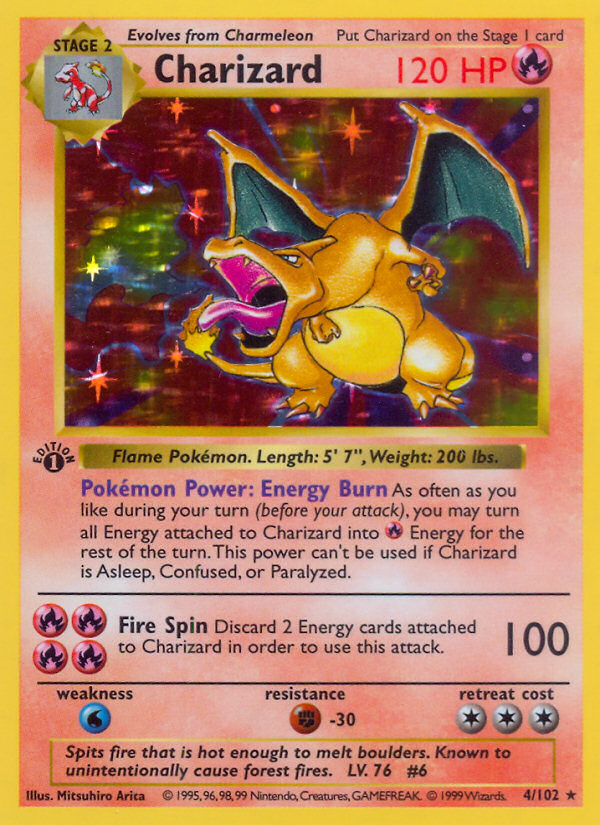
Check three things, in order. A black "Edition 1" stamp under the art means 1st Edition. No stamp and no shadow behind the art box means Shadowless. A soft gray drop shadow down the right of the art box means Unlimited. The stamp confirms 1st Edition, the shadow separates the other two, and the HP font is the tiebreaker.
- The 1st Edition stamp is the only tell that settles the question on its own. Stamp present means 1st Edition, full stop.
- The drop shadow separates Shadowless from Unlimited: Unlimited has it, Shadowless does not.
- Each print wave is roughly 10x to 30x scarcer than the next, which is why PSA 10 prices jump a full tier at each step.
- Shadowless is the most mislabeled variant online. Confirm the shadow yourself before paying the premium.
- Jungle and Fossil skipped Shadowless entirely, so for those sets it is just stamp or no stamp.
The 30-second test
You can sort any Base Set card into its print wave with three checks. Run them in this order and you will be right almost every time, even across a dealer case under bad light.
| Print wave | The tell | Print window | PSA 10 Charizard |
|---|---|---|---|
| 1st Edition | Black "Edition 1" stamp under the art | Roughly two months, early 1999 | Six figures |
| Shadowless | No stamp, and no shadow behind the art box | A few weeks, spring 1999 | Low-to-mid five figures |
| Unlimited | Gray drop shadow down the right of the art box | Years, from mid-1999 on | Four figures |
The three diagnostics, in order of reliability
1. The drop shadow
Look at the right edge of the central art box. Unlimited prints carry a soft gray shadow running down that edge, as if the art floats slightly above the yellow border. Shadowless and 1st Edition prints have none; the frame sits flat against the yellow. This is the fastest tell when a card is sleeved and you are reading it across a table under fluorescent light.
2. The 1st Edition stamp
Look at the lower left of the art box. 1st Edition prints carry a small black stamp that reads "Edition 1" inside an oval outline. Shadowless and Unlimited do not. This is the only tell that settles the variant by itself: if the stamp is there, the card is 1st Edition. If there is no stamp and no drop shadow, it is Shadowless.
3. The HP font
Check the HP in the top right corner. On Shadowless prints the digits are noticeably thinner and lighter than on Unlimited. For Charizard that is the "120 HP." The difference is real but subtle, and it photographs badly, so treat it as confirmation rather than your first move.
Why the prices diverge so far
It comes down to pure scarcity. 1st Edition ran for about two months in early 1999. Shadowless was a short transitional print over the weeks that followed, before Wizards settled into the Unlimited print they kept running for years. Each step up the chain represents roughly a 10x to 30x drop in surviving population, and PSA 10 prices stack a full tier at every step to match.
A stamp the size of a grain of rice is the difference between a few hundred dollars and a down payment.
Jungle and Fossil are simpler
Neither set produced a Shadowless wave. They went straight from 1st Edition to Unlimited, so the only question is whether the "Edition 1" stamp is present. The one extra wrinkle is the early Jungle No Symbol error, where the rarity symbol is missing from the lower right. That is its own variant, covered in the holo and error guides.
Common questions
- What is the easiest way to tell Shadowless from Unlimited?
- Look for the drop shadow on the right side of the central art box. Unlimited prints have a soft gray shadow there; Shadowless prints do not. If there is no shadow and no "Edition 1" stamp, the card is Shadowless.
- Is every 1st Edition card also Shadowless?
- In one sense yes: 1st Edition prints have no drop shadow, the same as Shadowless. The difference is the stamp. 1st Edition cards carry the "Edition 1" stamp, while Shadowless is the stampless version of that same early print style.
- Do Jungle and Fossil have Shadowless versions?
- No. Only Base Set produced a distinct Shadowless run. Jungle and Fossil went straight from 1st Edition to Unlimited, so for those sets you only need to check for the 1st Edition stamp.
- Does the variant matter for commons, or only for holos?
- It matters most for holo rares like Charizard, where the spread between waves is enormous. It still affects commons and uncommons, just in smaller dollar terms. A Shadowless common is worth more than its Unlimited twin, but the gap is cents to dollars, not thousands.