
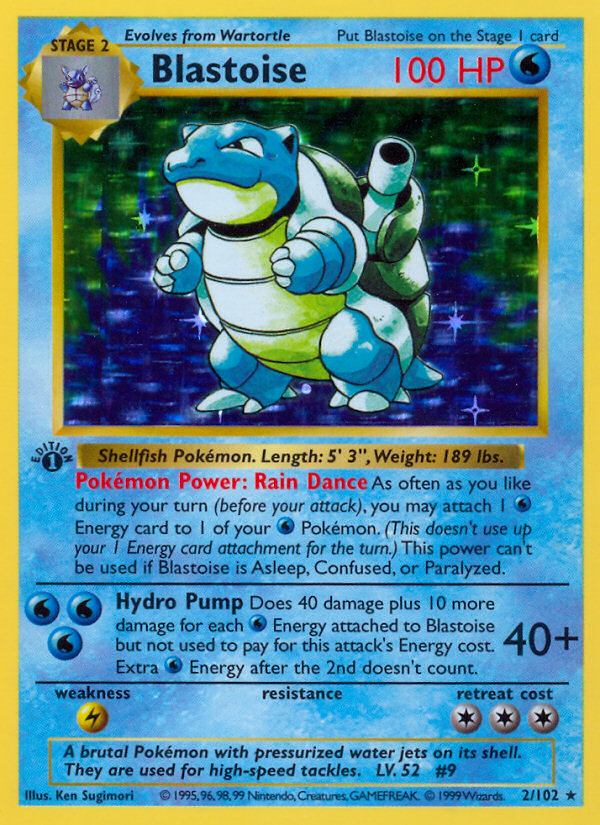
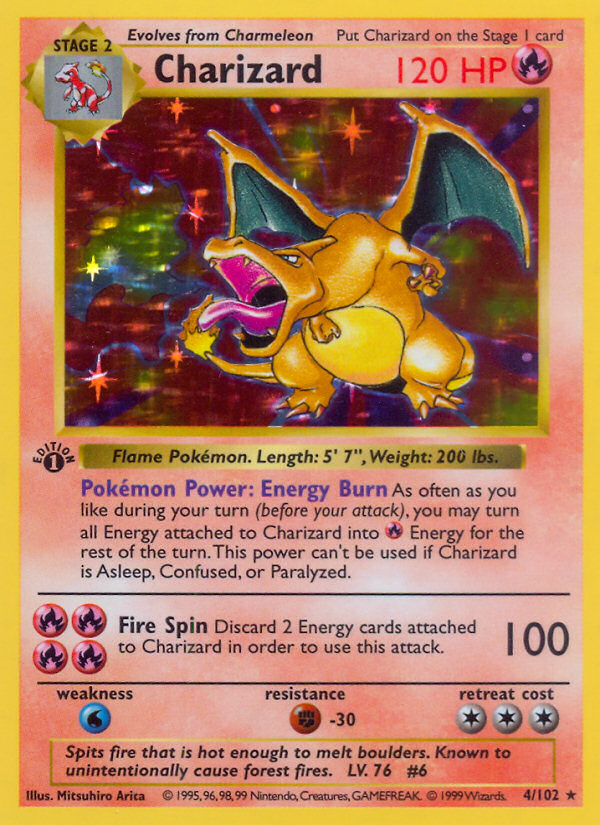
Base Set ran in three waves in 1999. 1st Edition came first, January to early March, with the stamp under the art. Shadowless followed for a few weeks, no stamp and no shadow. Unlimited ran for years with the drop shadow and heavier HP font. Each wave is scarcer than the next, and prices follow.
- 1st Edition ran roughly January to early March 1999, the shortest of the three waves.
- Shadowless was an unstamped transitional print that Wizards never officially named; collectors did, later.
- Unlimited ran for years and is the bulk of surviving cards, yet high grades stay scarce because kids opened the boxes.
- Wizards never disclosed print numbers; PSA and CGC population reports are the only public proxy.
- Basic Energy cards skipped Shadowless entirely, going straight from 1st Edition to Unlimited.
Three waves, one year
Every English Base Set card belongs to one of three print waves, all run inside 1999 and the years just after. The differences come down to a stamp, a shadow, and the cardstock underneath. Here is the timeline at a glance before we walk each wave.
| Print wave | Window | The tell | What survives |
|---|---|---|---|
| 1st Edition | January to early March 1999 | Black "Edition 1" stamp under the art | The scarcest wave; smallest graded pops |
| Shadowless | A few weeks, spring 1999 | No stamp, no drop shadow, lighter HP font | Scarcer than Unlimited, more common than 1st Ed |
| Unlimited | Mid-1999 onward, several years | Gray drop shadow, heavier HP font | The vast majority of cards, but few in high grade |
1st Edition: January to early March 1999
The first English Base Set print ran from the January 9, 1999 release through roughly early March. The "Edition 1" stamp under the artwork was a print-run identifier meant to flag launch product. Wizards never disclosed exact quantities, so population reports from the major graders are the only public proxy for how many were made.
The 1st Edition print used a slightly off-gray cardback compared with later waves, and the holo cards are fractionally less saturated. Experienced collectors can read these cues, but they are confirmation, not primary authentication. The stamp does that job.
Shadowless: the transitional window
After Wizards retired the stamp, the printer kept running cards without it, but also without the drop shadow that would later define Unlimited. That in-between print is what collectors named Shadowless. Wizards never acknowledged it as a separate edition; the name came later, from the cosmetic differences. The window is usually estimated at four to six weeks, though it has never been firmly documented.
Shadowless shares the lighter HP font and lower saturation of 1st Edition. One data point pushes back on the lore: the PSA graded population for Shadowless Charizard PSA 10 is meaningfully higher than for 1st Edition PSA 10, which suggests the Shadowless window ran longer than collectors tend to credit.
Unlimited: the long tail
Unlimited introduced the gray drop shadow down the right of the artwork, a heavier HP font, and a slightly different cardback color. Wizards produced it for several years, so it accounts for the overwhelming majority of surviving Base Set cards. The catch for grading: these boxes were opened and played by kids, which is why a high-grade Unlimited card is far scarcer than the long print run implies.
Other Base Set print artifacts
Square-cut variant
A small number of 1st Edition Base Set cards show sharper, square-cut corners from a different cutting process. Graded, they carry a meaningful premium. The corners have to be definitively factory-cut, not the product of sleeve wear, so this one rewards a careful look under magnification.
Miscuts and miscolors
Production errors get tracked separately by the graders: miscuts that show a sliver of the adjacent card, ink saturation problems, holo printed in a non-holo position. Some of the famous miscuts trade for double or triple the standard print in the same grade.
Common questions
- How long did the 1st Edition print run last?
- Roughly two months, from the January 9, 1999 release into early March. Wizards never published figures, so the window is reconstructed from release dates and grading population data rather than official numbers.
- Is Shadowless an official Wizards edition?
- No. Wizards never named or acknowledged Shadowless. It is the unstamped print that ran between 1st Edition and Unlimited, before the drop shadow appeared. Collectors named it later from the cosmetic differences.
- Why are high-grade Unlimited cards still scarce?
- Unlimited printed for years, so raw copies are common. But the boxes were opened and played by kids, so survivors in PSA 9 or 10 condition are far rarer than the long print run suggests.
- Are there Shadowless Energy cards?
- No. Basic Energy cards went straight from 1st Edition to Unlimited and skipped the transitional print. A listing for a 'Shadowless' Energy is almost always miscategorized.