Jigglypuff · Jungle, what to know.
About the Jigglypuff card
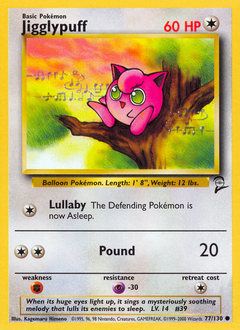
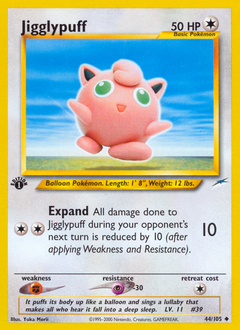
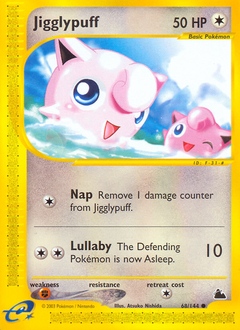
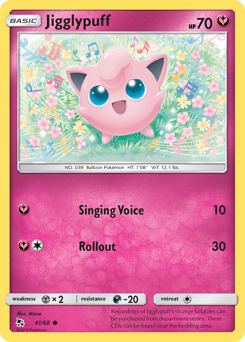
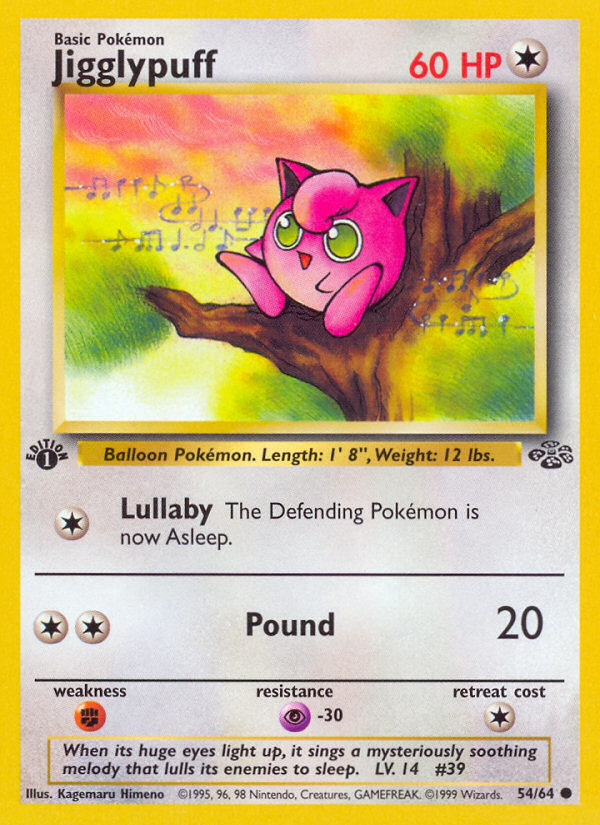
Jigglypuff is card 54 of 64 in Jungle, released in June 1999, a Common. It is a Basic Colorless-type with 60 HP.
As a Basic Pokémon, Jigglypuff needs no prior evolution to put into play, which made it a practical card in the era's decks.
Illustrated by Kagemaru Himeno. Himeno is one of the most-recognized vintage illustrators, with a softer, more textured style that shows up across the Jungle and Neo runs.
The card's flavor text gives Jigglypuff a line of lore: "When its huge eyes light up, it sings a mysteriously soothing melody that lulls its enemies to sleep."
About Jigglypuff in the Pokémon world
A round pink Pokémon that puts opponents to sleep with its song. Famously absent from the original Pokédex art for being too similar to Clefairy. Jungle Jigglypuff is a Common with sentimental appeal. Cheap, easy to find raw, easy to grade.
What is Jigglypuff worth?
Jigglypuff is a Common, so raw copies trade for very little and most of the print run survives. The only real value is in pristine, high-grade copies, where even a Common can reach low triple digits in 1st Edition PSA 10. See the live price above for the current figure by grade.
Print variants and how to spot them
Jungle shipped in 1st Edition and Unlimited, with no Shadowless print. The Edition 1 stamp under the artwork separates the scarcer 1st Edition Jigglypuff from the Unlimited copy. The set also has the famous No Symbol error from its first print run, which adds a premium when the lower-right set symbol is missing.
Grading and condition
Jigglypuff is the most forgiving tier to grade in the set. Centering on the framed border is the usual cap, and the soft Wizards-era cardstock picks up edge whitening easily, but high print runs keep clean copies affordable.
If you are collecting Jigglypuff
Raw copies of Jigglypuff are inexpensive enough that grading rarely pays unless you have a clearly pack-fresh example. For set completion, a clean sleeved Jigglypuff is the practical move.
Three prints, three markets.
Edition 1 stamp under the artwork. Trades above Unlimited in matching grade.
No stamp. The standard, more affordable print.
Early first-run print missing the lower-right set symbol. Carries a premium.