Wigglytuff · Jungle, what to know.
About the Wigglytuff card
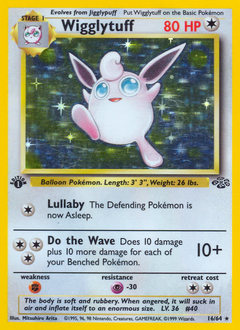
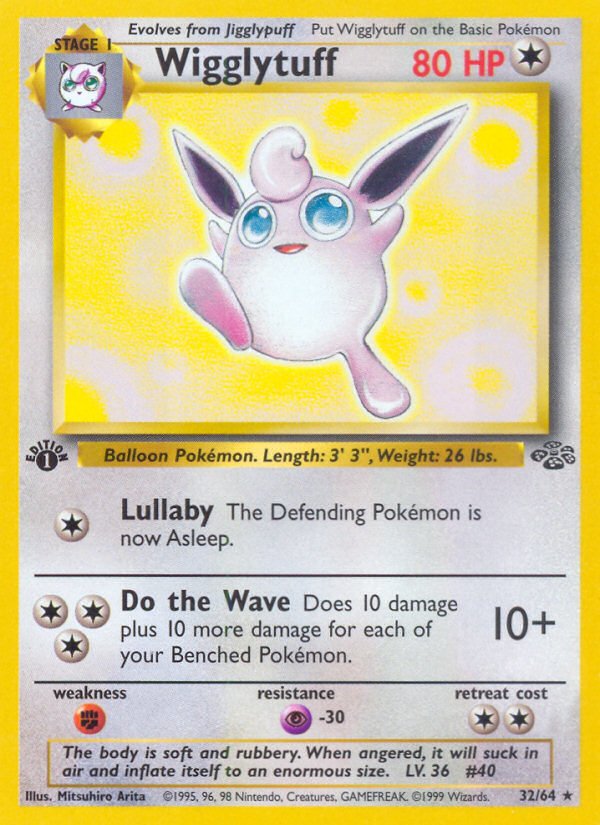
Numbered 32 of 64 in Jungle, released in June 1999, Wigglytuff is a Rare, a Stage 1 Colorless-type carrying 80 HP.
It evolves from Jigglypuff, so Wigglytuff is a later-stage card that set-builders usually slot into a full evolution run rather than buy alone.
Illustrated by Mitsuhiro Arita. Arita painted the Base Set Charizard and much of the early holo run, and his work has a painterly weight that set the visual tone of the Wizards era.
Wigglytuff carries this Pokédex flavor text: "The body is soft and rubbery. When angered, it will suck in air and inflate itself to an enormous size."
About Wigglytuff in the Pokémon world
The fully evolved Jigglypuff. Larger, fluffier silhouette. Jungle holo Wigglytuff is a quiet collector favorite. Underpriced relative to other Jungle holos.
What is Wigglytuff worth?
Based on recent eBay sales, raw copies trade from $2.5 to $14 depending on the print and a PSA 10 runs from $100 to $400. The 1st Edition print is the most valuable, with a PSA 10 near $400. The table on this page breaks the price down by print and grade, updated 2026-05-27.
Print variants and how to spot them
Jungle shipped in 1st Edition and Unlimited, with no Shadowless print. The Edition 1 stamp under the artwork separates the scarcer 1st Edition Wigglytuff from the Unlimited copy. The set also has the famous No Symbol error from its first print run, which adds a premium when the lower-right set symbol is missing.
Grading and condition
On Wigglytuff, look at the corners and the framed border first. Non-holo Rares took more handling than the chase holos, so a sharp, centered copy of Wigglytuff in a true PSA 10 is harder to find than the print run suggests.
If you are collecting Wigglytuff
For Wigglytuff, check centering by eye, edge whitening on all four sides, and surface under angled light. Non-holo Rares from this era are cheap enough that a PSA 10 submission on a clean Wigglytuff can make sense.
Three prints, three markets.
Edition 1 stamp under the artwork. Trades above Unlimited in matching grade.
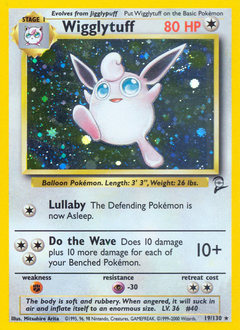
No stamp. The standard, more affordable print.
Early first-run print missing the lower-right set symbol. Carries a premium.