Cinderace · Sword & Shield, what to know.
About the Cinderace card
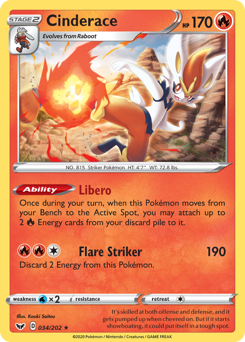
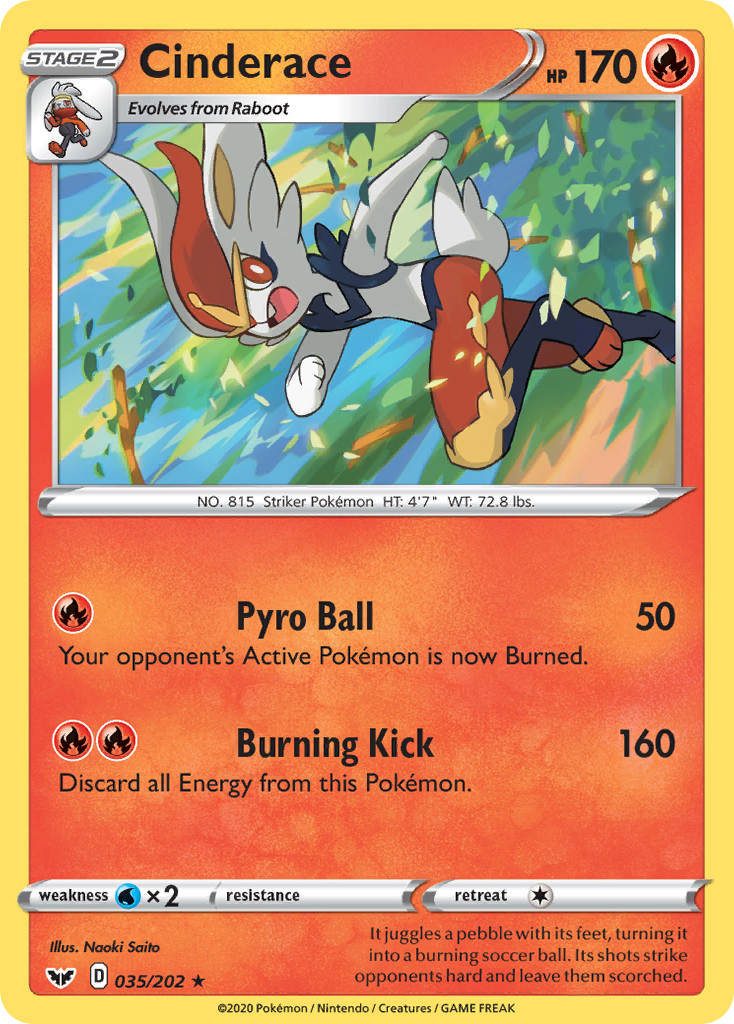
Cinderace is card 35 of 216 in Sword & Shield, released in February 2020, a Rare Holo. It is a Stage 2 Fire-type with 170 HP.
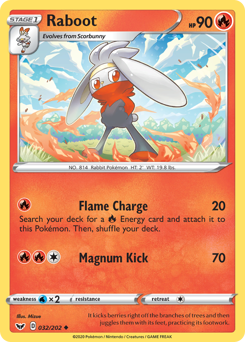
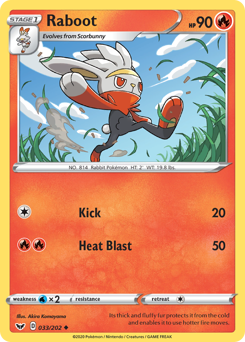
As a Stage 2, it evolves from Raboot, which places Cinderace deeper in its line and means most collectors hold it alongside the cards it evolves from.
Illustrated by Naoki Saito.
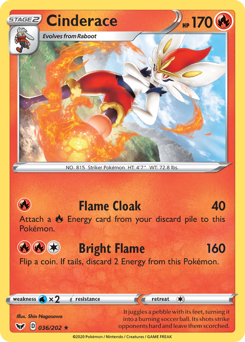
The card's flavor text gives Cinderace a line of lore: "It juggles a pebble with its feet, turning it into a burning soccer ball. Its shots strike opponents hard and leave them scorched."
What is Cinderace worth?
Cinderace is a holo rare, one of the cards that holds Sword & Shield's value. The rarity tier decides most of it, since the same card prints at several tiers with very different prices. In top-grade 1st Edition, Sword & Shield holos range from the mid hundreds for the lesser cards up to the set's marquee chase; raw and Unlimited copies trade for a fraction of that. The live market price above shows the current figure by grade.
Print variants and how to spot them
Confirm the print and finish on Cinderace before pricing it, since variant and rarity set the market more than the card name alone.
Grading and condition
On a holo like Cinderace, surface is the grade cap. The fire foil shows hairlines under raking light, and the print reveals scratches that flat scans miss. Centering on the left and right borders is the second thing to check.
If you are collecting Cinderace
Buying Cinderace well means pricing the exact print and grade, not the card name. Match the rarity tier to the comp before you buy. Always see the holo surface in good light first.