Haunter · Base Set 2, what to know.
About the Haunter card
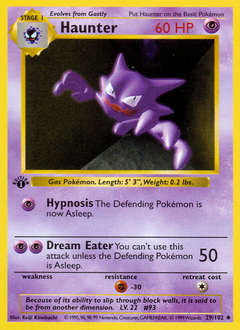
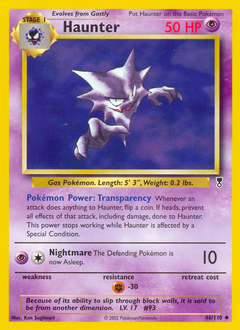
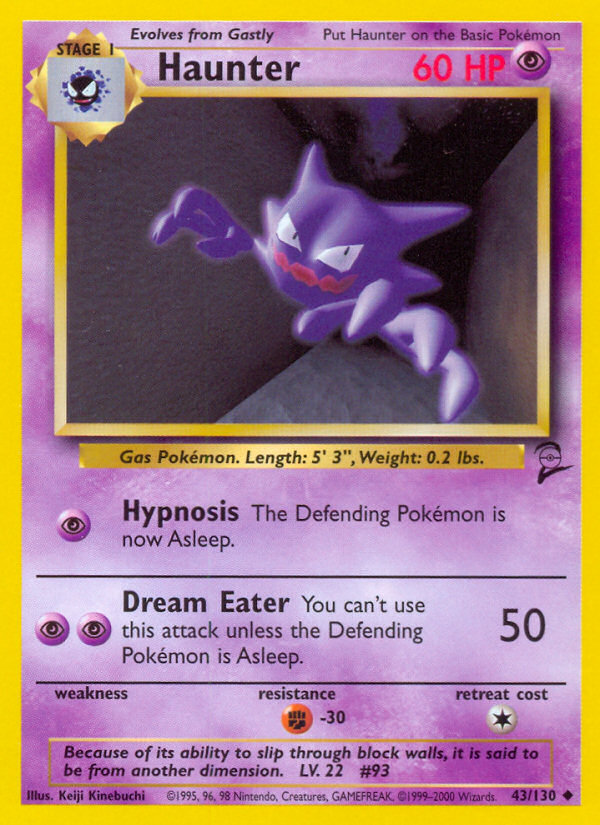
Haunter is card 43 of 130 in Base Set 2, released in February 2000, an Uncommon. It is a Stage 1 Psychic-type with 60 HP.
As a Stage 1, it evolves from Gastly, which places Haunter deeper in its line and means most collectors hold it alongside the cards it evolves from.
Illustrated by Keiji Kinebuchi. Kinebuchi contributed a smaller body of Wizards-era cards but is responsible for several memorable holos, with a warm, heavily textured style.
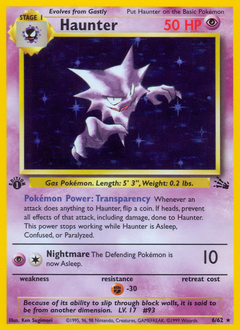
The card's flavor text gives Haunter a line of lore: "Because of its ability to slip through block walls, it is said to be from another dimension."
About Haunter in the Pokémon world
The middle Gastly stage. Floating, tongue-out, mischievous. Fossil holo Haunter is a quiet collector favorite. Its anime presence (the friendly Haunter in the Tower of Lavender episode) gives it an emotional draw.
What is Haunter worth?
Haunter is an Uncommon, so raw copies are inexpensive and easy to find. The value is in condition: a genuine PSA 10, especially 1st Edition, can still reach a surprising figure for an otherwise common card. The live price above breaks it down by grade.
Print variants and how to spot them
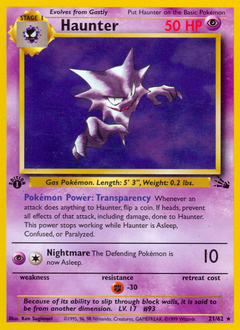
Base Set 2 produced Unlimited prints. For Haunter, the print variant can change the price several times over, so identify it before you buy.
Grading and condition
Haunter grades forgivingly, but the same centering and edge standards apply. Pack-fresh raw copies are easy to find, which makes a clean PSA 10 submission a low-cost way to learn how the cardstock behaves under grading.
If you are collecting Haunter
Raw copies of Haunter are inexpensive enough that grading rarely pays unless you have a clearly pack-fresh example. For set completion, a clean sleeved Haunter is the practical move.