
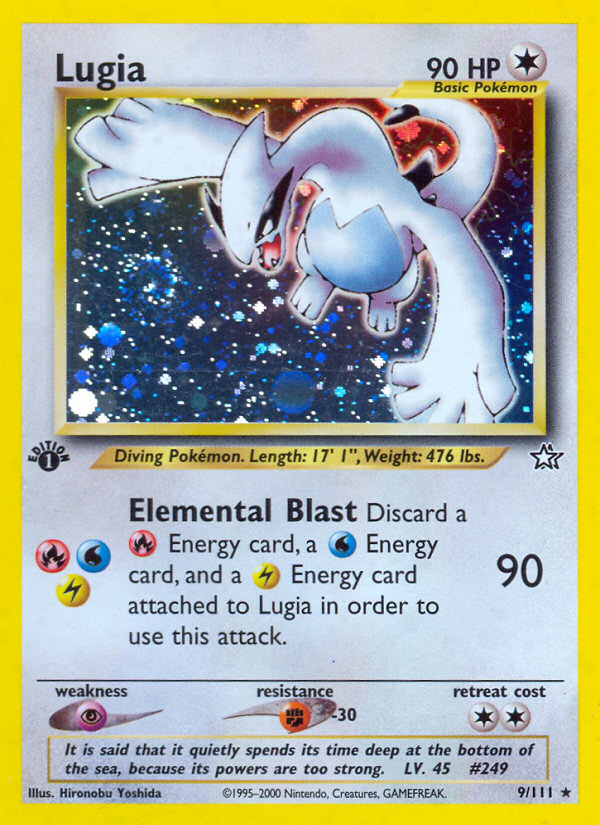
Neo Genesis Lugia is the Wizards-era card that trades highest in equivalent grade. The 1st Edition PSA 10 sits in the low six figures off a global population near 50, driven by thin supply, iconic art, and borders that punish graders. Unlimited and Japanese copies cost far less for the same picture.
- The 1st Edition PSA 10 trades in the low six figures off a population of roughly 50 worldwide.
- Dark borders and a holo-bleed-prone cardstock make Lugia one of the hardest Wizards cards to grade gem mint.
- Unlimited PSA 10s run $5k to $8k, so the 1st Edition stamp carries almost the entire price.
- Japanese Lugia grades 10 far more often and costs $8k to $15k, the value route to a gem copy.
- Plan to inspect about ten raw copies before one is a credible PSA 10 candidate.
The card
Lugia #9 from Neo Genesis, the first Generation 2 expansion, released in English in December 2000. A centered Lugia rides a stormy sea, art by Hironobu Yoshida, on the Wizards cosmos holo pattern. Both 1st Edition and Unlimited prints exist, and the gap between them is enormous.
| PSA 10 (2026) | What you are paying for | |
|---|---|---|
| English 1st Edition | $120k to $150k | Roughly 50 PSA 10s worldwide; the ceiling card |
| English Unlimited | $5k to $8k | Same art, no stamp, a far larger population |
| Japanese (Neo 1) | $8k to $15k | Better cardstock, grades PSA 10 far more often |
Why the population is so thin
Two forces work against a gem grade. First, the early Neo cardstock handled the holo edge poorly, so many copies show holo bleed onto the surrounding art. Graders read that as a print defect and cap the grade below a 10. Second, the borders are very dark, which makes any edge whitening jump out. A black-bordered Wizards card is about the hardest grading target the hobby offers.
As of 2026, the PSA 1st Edition Lugia population is roughly 50 PSA 10s globally. For comparison, 1st Edition Base Set Charizard sits near 120. The population disparity is what drives the price disparity.
The price trajectory
A 1st Edition Lugia PSA 10 traded around $30k in 2018, hit roughly $100k by the 2021 peak, slid to about $75k in 2023 during the broader vintage reset, and has stabilized in the $120k to $150k range through 2025 and into 2026. PSA 9 and PSA 8 floors have tracked the same curve at proportionally smaller numbers.
Why collectors keep buying it
Three demand drivers stack. Lugia is a centerpiece Pokémon, the Gold and Silver mascot and the face of the second movie. The card art is widely considered the best holo Wizards ever printed. And the PSA 10 scarcity is real, not manufactured. Together they make Lugia the most-recommended single-card hold in the Wizards-era investment community.
Buying raw
Three defects sink most raw copies, in order: holo bleed at the lower right of the artwork window, border whitening on the four corners, and surface scratches in the dark holo. Expect to inspect about ten copies before one has a genuine PSA 10 chance. Pay a PSA 10 premium for a raw card and you are paying for an uncertain outcome.
Same picture, three price tiers, and a stamp the size of a fingernail decides which one you are holding.
The Japanese value play
The Japanese Neo Genesis Lugia (Neo 1, #9) was printed on better cardstock and grades PSA 10 at much higher rates. Japanese PSA 10 copies sit in the $8k to $15k range. For a collector who wants a gem Lugia without the English 1st Edition price, it is the value route.
Common questions
- How many PSA 10 1st Edition Lugias exist?
- Roughly 50 worldwide as of 2026, against about 120 for 1st Edition Base Set Charizard. That gap in population is the main reason Lugia trades higher than Charizard in the same grade.
- Why is Lugia so hard to grade?
- Two reasons. The early Neo cardstock often shows holo bleed onto the artwork, which graders treat as a print defect and cap below a 10. And the dark borders make even slight edge whitening obvious.
- Is the Unlimited Lugia worth buying?
- It is far cheaper, with PSA 10s around $5k to $8k versus six figures for 1st Edition. Just confirm the print: the 1st Edition stamp sits under the artwork, and buyers conflate the two constantly.
- Is Japanese Lugia a good alternative?
- Yes, if you want a gem copy on a budget. The Japanese print used better cardstock and grades PSA 10 far more often, with examples trading roughly $8k to $15k.